
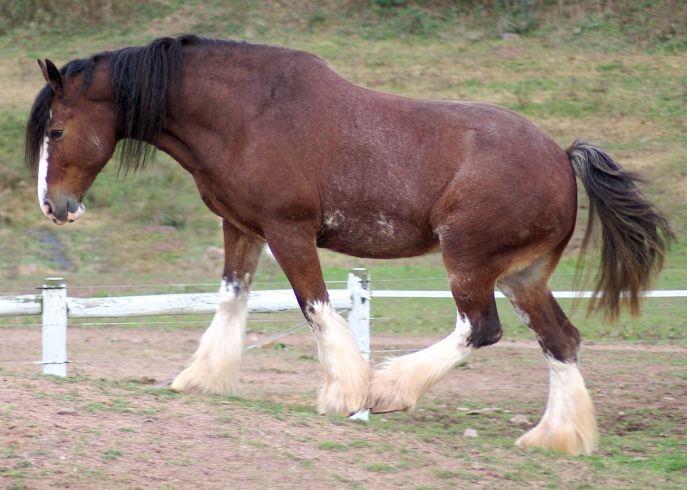
People usually look up Clydesdales when they’re weighing up a big, feather-legged horse for farm work, driving, or a calm family mount—and want to know what’s true about size, temperament, care needs, and suitability.
Clydesdales can be steady and generous to handle, but they are still very large animals with specialised hoof-and-skin care needs (especially under the feathering). A small management slip can turn into a persistent problem. What follows keeps the facts grounded: where the breed comes from, what a typical Clydesdale looks like, what they’re used for in Australia today, and what their daily care really involves.
Clydesdale at a glance
- Height: commonly around 17–18 hands (about 173–183 cm)1
- Weight: commonly around 900 kg (about 2,000 lb), with variation by sex and type1
- Coat colours: usually bay, dark brown, or black with prominent white markings1
- Distinctive features: feathering (long hair) on the lower legs; strong bone and feet; active, high-stepping action1
- Temperament: widely described by breed bodies and equine references as calm/tractable when well-handled and trained2
- Life expectancy: often cited around 20–25 years in general equine references (individuals vary)3
- Origin: Lanarkshire, Scotland, near the River Clyde1
History and origin
The Clydesdale developed in Lanarkshire, Scotland, in the district around the River Clyde. Early improvement included the use of Flemish stallions over local mares, with Shire blood introduced later.1
As agriculture and freight expanded, Clydesdales spread beyond Scotland. A dedicated breed society was established in 1877 to formalise pedigrees and standards, and exports followed to many parts of the world, including Australia.1, 4
Physical characteristics
A mature Clydesdale is built for pulling: deep through the chest, heavily muscled, and supported by substantial bone. The breed is also known for its “feather”—the long hair that drapes over the lower legs—and for bold white markings, often with a blaze and white socks.1
That feathering is part of the appeal in the show ring and in ceremonial teams, but it also hides the skin. In wet weather or muddy paddocks, the area beneath the hair can stay damp, which is why careful cleaning and drying matter so much for this breed type.
Size: what the numbers really mean
Online summaries often disagree because they mix “average”, “show-type”, and “exceptionally large” horses. A reliable rule of thumb is that many adult Clydesdales sit around 17–18 hands and roughly the 900 kg mark, but individuals can be smaller or larger depending on sex, age, conditioning, and bloodlines.1
Clydesdales in Australia: work, showing, and driving
In Australia, Clydesdales are most visible in agricultural shows, parades, and harness work, where their movement and presence are part of the spectacle. Some are still used for light farm tasks and demonstrations of traditional horse power.
The Commonwealth Clydesdale Horse Society of Australia maintains a stud book and promotes breed standards and responsible breeding in Australia. (Note: the society’s establishment date is 1918, not 1902.)5
Sports and entertainment: correcting a common misconception
Clydesdales are not “often used” in elite racing such as the Grand National or the Melbourne Cup. Those are Thoroughbred steeplechase and Thoroughbred flat races, respectively, and Clydesdales are a heavy draught breed with very different biomechanics and purpose.
Where Clydesdales do appear, consistently, is in harness classes, breed shows, commercial promotion, and ceremonial work. Internationally, it’s hard to separate the modern image of the breed from the Budweiser teams, first shown to the public on 7 April 1933 as a celebration linked to the end of Prohibition in the United States.6
Training and care
Clydesdales generally respond best to quiet, consistent handling—clear cues, steady repetition, and enough time to think. Their size makes early education especially important: leading manners, standing tied, loading, picking up feet, and accepting harness or saddle calmly.
Feathering, skin, and hoof care
The feathering that looks so striking in a lineup can also trap moisture and mud against the skin. Owners commonly manage this with routine checks (hands-on, not just a glance), gentle washing when needed, thorough drying, and prompt attention to irritation or scurf before it becomes a deeper skin infection.
Chronic Progressive Lymphedema (CPL) is also recognised in feathered draught breeds, causing progressive swelling and skin changes in the lower legs. Early veterinary advice matters if you notice persistent thickening, swelling, or recurring dermatitis beneath the feathering.7
Diet and daily management
Like other horses, Clydesdales rely on forage as the base of the diet—good pasture and/or quality hay—adjusted to workload, condition, and season. Concentrates (such as grain mixes) are optional and should be matched to energy needs rather than size alone.
Because they carry more body mass, small changes in hoof balance, skin health, or body condition can have outsized consequences. Regular farriery, dental care, and planned conditioning are not optional extras in a big draught horse; they’re the quiet routine that keeps everything else easy.
Breeding and genetics
Breed societies and responsible breeders aim to preserve the Clydesdale’s type—bone, movement, markings, and temperament—while selecting against hereditary unsoundness. In practice, that means careful record-keeping, sensible mating choices, and veterinary input when concerns arise.5
Future of the breed and conservation
Globally, Clydesdale numbers have fallen from their working-era peak, and some conservation organisations classify the breed as “Vulnerable” in the UK, reflecting limited breeding populations compared with modern commercial breeds.8
In Australia, ongoing registration, breeding programs, and public visibility at shows help keep the breed present and practical, rather than purely nostalgic. That work is slow and methodical—stud books, soundness, and owners who stick with big-horse care through every season.
Final thoughts
A Clydesdale is, first, a draught horse: built to pull, to step through heavy ground, and to carry itself with an unhurried kind of power. In the right hands, they can be calm, trainable partners for driving, showing, and everyday riding. The trade-off is simple and consistent—more horse means more management, especially in the legs and feet, where the feathering hides early trouble.
References
- Encyclopaedia Britannica — “Clydesdale” (breed overview, origin, height/weight, colour and characteristics)
- Clydesdale Horse Society (Great Britain & Ireland) — Breed society information and breed purpose
- Whittington Veterinary Clinic — “The Clydesdale Horse” (general breed care notes and typical lifespan range)
- Clydesdale Horse Society (Great Britain & Ireland) — Society initiated and launched in 1877 (stud book history)
- Commonwealth Clydesdale Horse Society Australia — Society purpose and establishment (1918), stud book and breed standards focus
- MLB.com — History note on Budweiser Clydesdales first public appearance (7 April 1933)
- MSD Veterinary Manual — Chronic Progressive Lymphedema (CPL) in horses
- Rare Breeds Survival Trust — Watchlist entry for Clydesdale horse (UK conservation status)

Veterinary Advisor, Veterinarian London Area, United Kingdom